
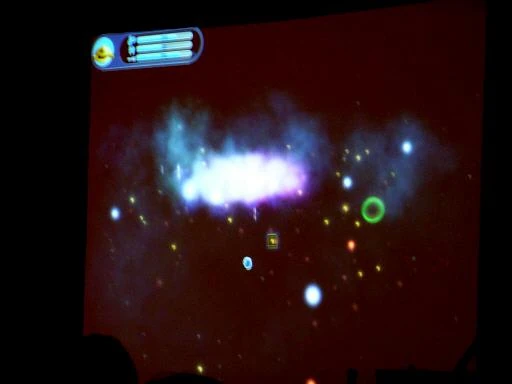

Picture of the galaxy ("stellar zoo") in the GDC demo.
This page is the main page for all objects that will, can or could play a part in the "Stellar Zoo" of the Galaxy. That is, the things that make up the stellar environment in the Space stage of Spore.
Known Galactic Objects
- Black Holes
- Binary Systems-BinaryOO, BinaryOM, BinaryMM, BinaryOG, BinaryGG and BinaryGM.
- Galactic Core
- Proto-Planetary Disks
- Stars
- Supernovae
- Steve
- Blue Giants
- Red Dwarfs
- Yellow Stars
- Planets
- Moons
- Nebulae (only decorations)
- Nearby galaxies (only decorations)
Stars[]
Star systems are notable for being the areas from which the player zooms in to interact with a planet.
The stars themselves serve few purposes, other than housing the various planets of the galaxy and serving as the primary mode of transportation i.e. jumping from star to star to travel the galaxy. Will Wright in Gaming Steve's interview said about the number of stars and worlds in the Spore galaxy:
- "Oh, well, there will be probably well over a hundred thousand. I mean, far more than a player could ever visit. Which is why there is no point to having another galaxy. If there are going to be thousands of stars in a galaxy there is no way that one person in their lifetime could ever visit them all."1
Multiple star systems[]
Binary stars are simply two stars in stable orbit around a common center of gravity.
Only binary stars exist in the current version of Spore.
Binary systems are in the game, as about a quarter of all star systems are estimated to have at least two stars. In reality, star systems can be referred to as follows:
- Single star
- Binary star
- Triple star
- Quadruple star
- Quintuple star
- Sextuple star
Stellar evolution[]
Stellar evolution can sometimes be noticed in Spore.
Planets[]
A planet is a stellar body orbiting any type of star that produces spice, has a T-score, can be colonized, and other topics.
Moons[]
There is no real difference between a moon and a planet. Colonization, T scores, as well as all other aspects of planets, are the same on moons. The only difference is that they appear slightly smaller.
Binary planets[]
Two planets that orbit each other whilst orbit their parent star.
Black holes[]
Black holes have been seen in the stellar zoo. The only purpose they serve is as a means or leaping over vast distances of space, a job that in reality, would go to Wormholes
Nebulae[]
It seems like in the game, the nebulae are only decorations to the galaxy.
Galactic core[]
Galactic core is a supermassive black hole in the center of galaxy. To get there is the final purpose of the game. You'll need some time and decent amount of repair kits to survive while fighting/allying with Grox. Additional information is in the Galactic Core article.
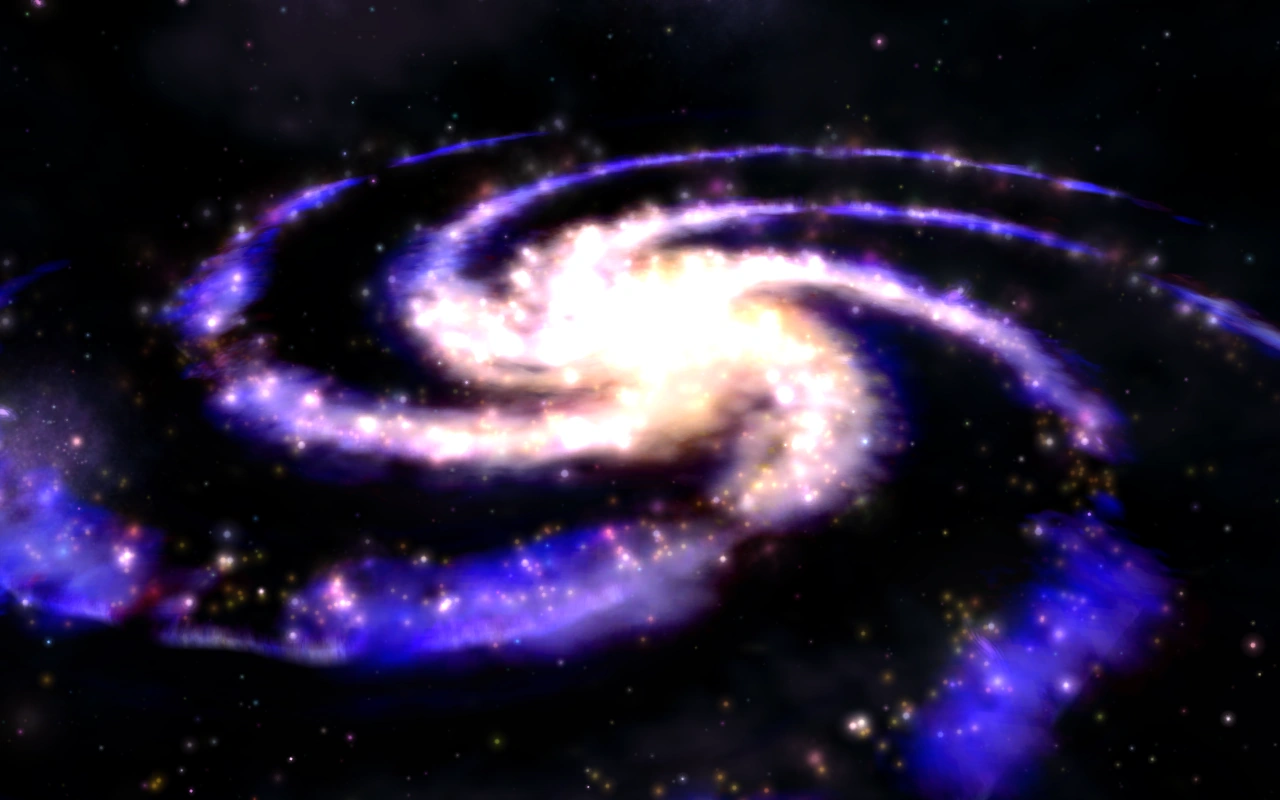

A complete view of the Spore Galaxy.
Galactic View[]
The Galactic View is where you can see all the stars in the galaxy, however, they are blurred together so they cannot be identified. There are two ways to view it,
- From the main menu where you select a planet to start playing Spore, or
- Zooming all the way out in the Space stage.